Gas Station Construction Jacksonville FL: Costs, Regulations & Timeline
Gas station construction in Jacksonville, FL requires specialized expertise in underground storage tank (UST) installation, Florida Department of Environmental Protection (FDEP) compliance, hurricane-rated canopy engineering, and petroleum facility permitting. A typical 8-pump station with 3,000-square-foot convenience store costs $2.8 to $4.2 million and takes 9 to 14 months from site acquisition to grand opening, depending on environmental assessments, FDEP permitting timelines, and municipal approval processes.[1] WFO Construction has completed gas station projects across the Southeast since 2005, navigating the unique regulatory landscape that governs petroleum facility construction in Florida.
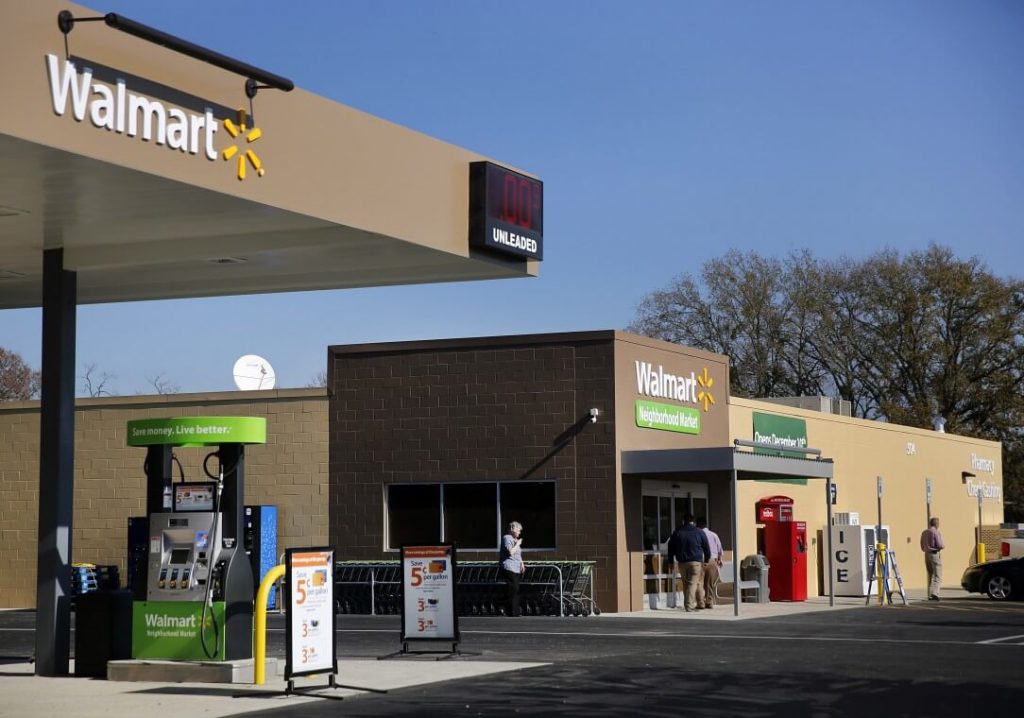
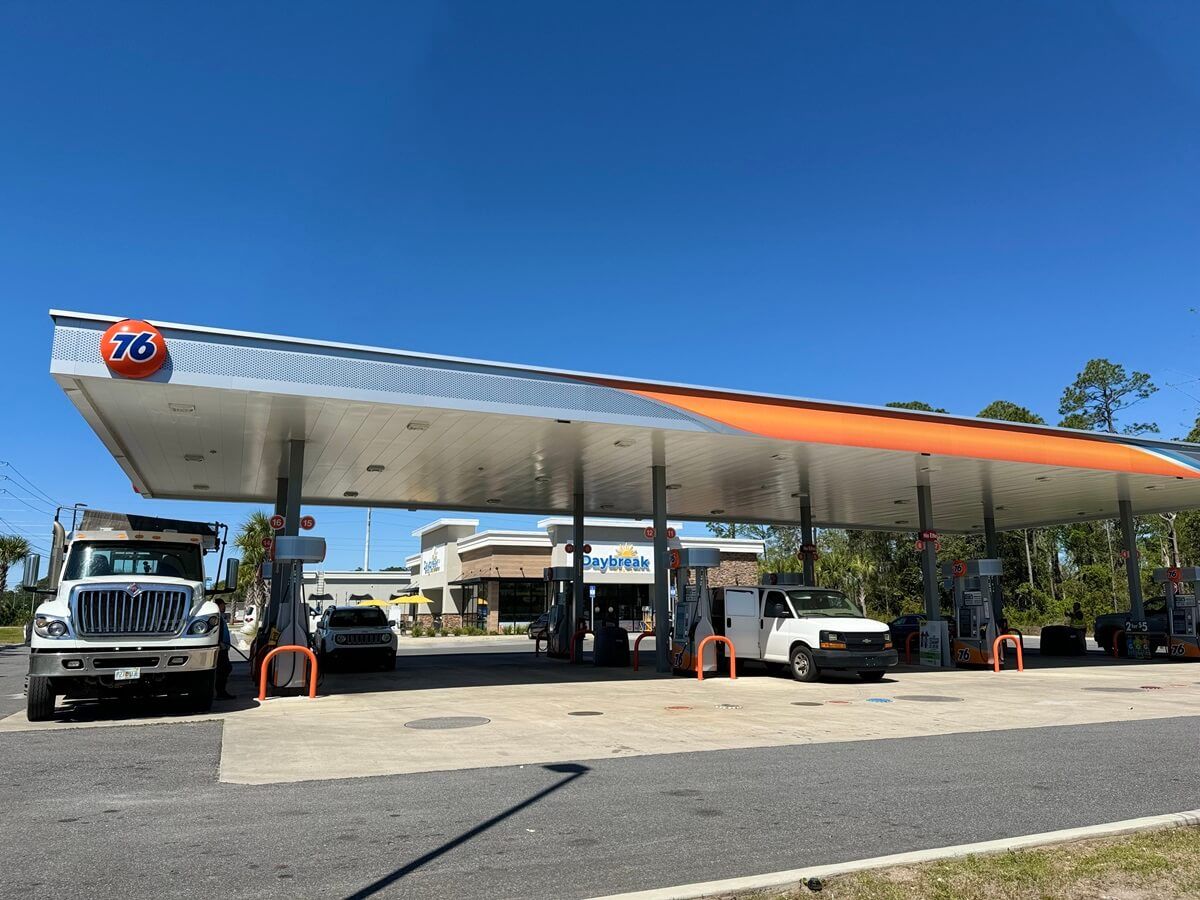
Hurricane-rated canopy installation at a Jacksonville gas station project, engineered for 140+ mph wind loads per Florida Building Code requirements.
What Are the Major Components of Gas Station Construction in Jacksonville?
Gas station construction comprises five critical systems: underground storage tanks and piping, fuel dispenser islands with concrete pads, structural canopy and lighting, convenience store building, and site infrastructure including stormwater management. Each system must meet overlapping jurisdictional requirements from local building departments, FDEP petroleum storage regulations, and federal EPA standards for spill prevention and vapor recovery.[2]
Underground storage tank (UST) installation represents the most regulated component. Florida Administrative Code Chapter 62-761 mandates double-walled fiberglass tanks with continuous electronic leak detection, overfill prevention devices, and spill containment basins at fill ports.[3] Jacksonville stations typically install three to six tanks ranging from 10,000 to 30,000 gallons each, positioned to optimize delivery truck access while maintaining required setbacks from property lines, buildings, and water sources. Tank excavation requires dewatering systems in Jacksonville’s high water table conditions, shoring to prevent collapse in sandy soils, and coordination with environmental consultants for soil sampling during excavation.
Fuel dispenser islands require reinforced concrete pads designed for 80,000-pound delivery truck loading, with embedded conduit for power and data communication to the point-of-sale system. NFPA 30A mandates specific clearances between dispensers, canopy columns, and the convenience store building to allow emergency vehicle access and reduce fire spread risk.[4] Modern dispensers incorporate Stage II vapor recovery systems (required in many Florida counties), EMV payment terminals, and high-speed fueling capabilities up to 10 gallons per minute for diesel lanes serving commercial vehicles.
How Does Canopy Engineering Differ in Florida?
Gas station canopies in Jacksonville must be engineered for 140 mph wind speeds per Florida Building Code Section 1609, significantly exceeding requirements in most other states. The coastal wind exposure category and hurricane risk demand structural steel or laminated wood beam systems with reinforced concrete foundations extending 8 to 12 feet deep, often requiring auger-cast piles in areas with poor bearing soils.[5] Canopy design must also accommodate integrated LED lighting (typically 50 to 80 foot-candles at grade), signage attachment points rated for wind loads, and conduit pathways for future technology upgrades. Our construction capabilities include in-house coordination with structural engineers licensed in Florida to ensure canopy designs meet both brand standards and Florida’s stringent wind resistance requirements.
What Does Gas Station Construction Cost in Jacksonville FL?
Total construction costs for a new gas station in Jacksonville range from $2.2 million for a small 4-pump site to $5.8 million for a high-volume 16-pump truck stop with expanded food service, excluding land acquisition. Cost variables include site conditions (contaminated soil requiring remediation adds $150,000 to $400,000), UST capacity and quantity, canopy size, convenience store finishes, and utility extension requirements.[1]
Component
4-Pump Station
8-Pump Station
16-Pump Truck Stop
Site Work & Utilities
$280,000 – $420,000
$450,000 – $680,000
$850,000 – $1,200,000
UST System (tanks, piping, monitoring)
$320,000 – $480,000
$520,000 – $750,000
$950,000 – $1,350,000
Fuel Dispensers & Islands
$180,000 – $240,000
$320,000 – $440,000
$720,000 – $960,000
Canopy (structure, lighting, soffit)
$240,000 – $360,000
$420,000 – $580,000
$780,000 – $1,100,000
Convenience Store (2,400 – 5,000 SF)
$480,000 – $660,000
$720,000 – $980,000
$1,200,000 – $1,650,000
Signage (pylon, canopy, building)
$85,000 – $125,000
$110,000 – $165,000
$180,000 – $280,000
Site work costs vary significantly based on existing conditions. Greenfield sites with suitable topography and no contamination represent the lowest cost scenario, while brownfield redevelopment of former gas stations requires Phase II environmental assessments, soil remediation, and often groundwater monitoring well installation. Jacksonville’s Coastal High Hazard Area designation affects sites east of Interstate 95, requiring additional foundation engineering and wind-resistant construction that adds 8% to 12% to structural costs.[5] Stormwater management represents a substantial cost component, with Florida’s strict discharge limits requiring retention ponds, oil-water separators, and in some cases proprietary treatment systems to meet St. Johns River Water Management District permits.
Convenience store construction costs depend heavily on interior finish specifications and food service equipment. Basic c-stores with grab-and-go offerings cost $200 to $275 per square foot, while facilities with expanded food service (roller grills, fryers, pizza ovens) and brand-specific millwork reach $320 to $420 per square foot.[6] Major brands require specific materials and layouts detailed in prototype design manuals, which our team implements across commercial construction projects throughout the Southeast. Walk-in coolers, point-of-sale systems, and security infrastructure add another $65,000 to $95,000 to the base building cost.
What Environmental and Regulatory Requirements Apply to Jacksonville Gas Stations?
Gas station construction in Jacksonville requires FDEP petroleum storage system registration, local building permits, St. Johns River Water Management District Environmental Resource Permits for stormwater, and compliance with EPA underground storage tank regulations under 40 CFR Part 280. The Florida Department of Environmental Protection serves as the primary regulatory authority for petroleum facilities, implementing standards that often exceed federal minimums.[3]
Before any excavation begins, developers must complete a Phase I Environmental Site Assessment to identify potential contamination from previous uses. If the Phase I identifies recognized environmental conditions, a Phase II assessment with soil and groundwater sampling becomes necessary. Discovery of contamination triggers Florida’s Brownfield Redevelopment Program requirements or Petroleum Contamination Site Cleanup criteria under Chapter 376, Florida Statutes. Remediation costs vary from $180,000 for limited soil excavation and disposal to over $800,000 for sites requiring soil vapor extraction systems or groundwater treatment.
FDEP petroleum storage system installation requires a Florida-licensed petroleum contractor for all UST work, separate from the general contractor license. Tanks must be tested and certified before backfilling, with inspections documenting proper installation of containment sumps, overfill alarms, and cathodic protection systems. The facility operator must register with FDEP’s Storage Tank Regulation Program and demonstrate financial responsibility for third-party liability coverage of $1 million per occurrence.[3] Ongoing compliance includes monthly electronic monitoring system checks, annual line tightness testing, and three-year tank integrity assessments.
How Do Jacksonville Zoning and Permitting Affect Project Timelines?
Jacksonville’s Consolidated Government permitting process typically requires 8 to 14 weeks from complete application submittal to building permit issuance, depending on whether the site requires rezoning or special exceptions. Sites zoned Commercial General (CG) or Commercial Community (CCG) allow gas stations by right, while other zoning districts require Planned Unit Development (PUD) approval through the Planning Commission, adding 3 to 5 months to the schedule.[7] Our experience with Jacksonville development projects demonstrates the importance of early coordination with city planners to identify zoning constraints, required traffic studies, and neighborhood notification requirements that can delay approvals if not addressed proactively.
Contact WFO Construction at (904) 435-3445 for a free bid, or submit your request online at wfoconstruction.com/request-a-bid/. Serving Jacksonville, FL and the Southeast since 2005.
What Is the Typical Construction Timeline for a Jacksonville Gas Station?
Gas station construction in Jacksonville averages 9 to 14 months from site acquisition to grand opening, with 3 to 5 months allocated to permitting and environmental review, 7 to 9 months for construction, and 2 to 4 weeks for final inspections and fuel system commissioning. Timeline variables include environmental remediation needs, weather delays during Florida’s summer rainy season (June through September receives 7 to 9 inches monthly), and petroleum equipment lead times that currently extend 12 to 16 weeks for dispensers and 10 to 14 weeks for UST systems.[8]
The critical path typically runs through UST installation and FDEP inspections. Tanks cannot be backfilled until FDEP or delegated county inspectors verify proper installation, and inspection scheduling often requires 2 to 3 weeks’ notice. Concrete work for dispenser islands and canopy foundations must wait until UST backfill is complete and compacted to prevent settlement. Florida’s lightning frequency (80 to 100 thunderstorm days annually in Jacksonville) causes frequent work stoppages during summer months, as electrical and structural steel work cannot proceed safely during storms.[5]
Convenience store construction proceeds on a parallel path once the foundation is complete. Interior finishes, refrigeration installation, and millwork typically require 10 to 14 weeks, followed by equipment installation and health department inspections. Final inspections include FDEP petroleum system certification, fire marshal approval of fire suppression and emergency shut-off systems, electrical inspection of classified hazardous locations per NEC Article 514, and weights and measures certification of fuel dispensers. Commissioning includes filling tanks, pressure testing all piping, calibrating leak detection systems, and conducting operational training for the facility operator.
How Does Convenience Store Design Integrate with Fuel Operations?
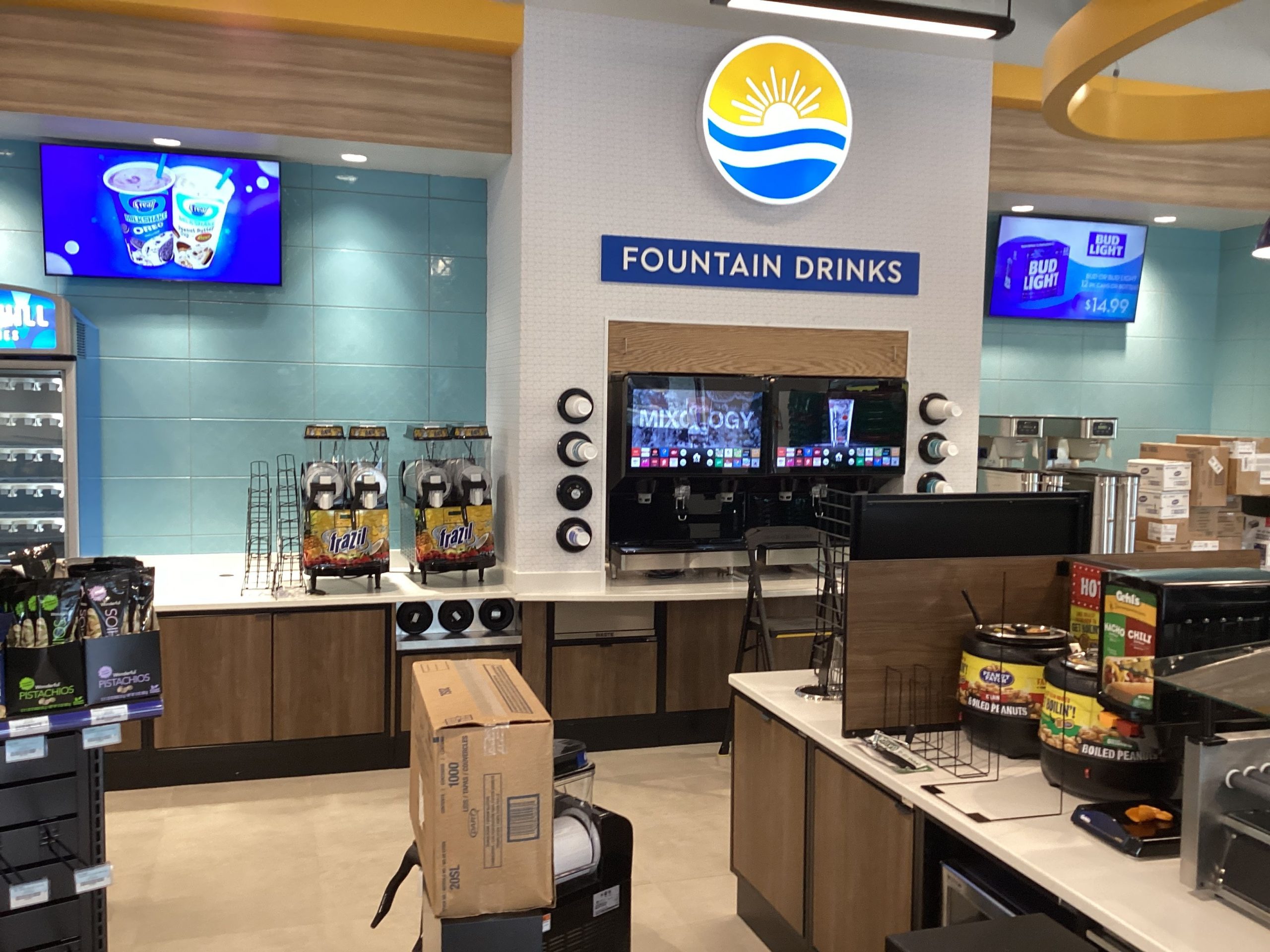
Modern convenience store layouts prioritize high-margin food service and merchandise visibility while maintaining efficient customer flow from fuel islands to checkout and back to vehicles. The building footprint typically ranges from 2,400 square feet for small-format sites to 5,000+ square feet for travel centers, with 60% to 65% dedicated to sales floor, 15% to 20% for back-of-house storage and restrooms, and 15% to 20% for food preparation areas in stores with expanded dining options.[6]
Entrance placement and window configuration balance natural light with security sightlines and energy efficiency in Florida’s cooling-dominated climate. Store orientation should provide clear sightlines from the cashier to fuel islands for safety monitoring, while separating food service queues from fuel payment lines to prevent bottlenecks during peak periods. Florida Building Code energy requirements mandate cool roof systems, high-efficiency HVAC equipment (minimum 14 SEER), and LED lighting throughout, which collectively reduce operating costs by 25% to 35% compared to older construction standards.[5]
Interior finishes must withstand high traffic while meeting brand standards. Polished concrete floors with densifier treatments provide durability and ease of maintenance, while ceramic tile in restrooms and food prep areas meets health code requirements. Refrigerated beverage cases typically line perimeter walls to encourage customers to walk past high-margin snacks and food service areas. Back-office design must accommodate point-of-sale servers, surveillance system recording equipment, and safe storage while providing manager workspace for inventory management and employee scheduling.
What Are the Key Differences Between Branded and Unbranded Station Construction?
Branded stations (Shell, BP, Chevron, etc.) require adherence to detailed prototype specifications for canopy design, signage, color schemes, and convenience store layouts, while unbranded operations allow greater flexibility but sacrifice brand recognition and fuel supply agreements. Major oil companies provide site development guidelines spanning 150 to 300 pages, specifying everything from canopy soffit materials to restroom fixture brands.[4] These requirements increase construction costs by 12% to 18% compared to unbranded facilities but deliver operational advantages including fuel supply contracts, credit card processing at wholesale rates, and participation in national loyalty programs.
Brand compliance requires submittal and approval processes at multiple construction milestones. Preliminary design concepts undergo review by the petroleum company’s real estate and construction departments before permitting begins. Foundation and framing inspections often include brand representatives verifying dimensions and materials match approved plans. Final brand inspections cover signage illumination levels, color matching, and merchandising plan implementation before the petroleum company authorizes fuel delivery and branding activation. Our team manages these coordination requirements across QSR and retail projects where brand compliance drives construction decisions.
Unbranded stations eliminate prototype compliance requirements but face challenges securing competitive fuel supply pricing and consumer trust. Construction cost savings come primarily from simplified canopy designs, flexible signage options, and reduced finish specifications in convenience store areas. However, unbranded operators must establish independent fuel supply contracts, invest in payment processing infrastructure, and build customer loyalty without the marketing support of major petroleum brands. The decision between branded and unbranded operation depends on site location, competitive context, and the owner’s operational expertise and capital availability.
Frequently Asked Questions
Do I need special licensing to build a gas station in Florida?Yes, gas station construction requires coordination between a Florida-licensed general contractor and a separate petroleum contractor licensed under Chapter 62-761, Florida Administrative Code, who performs all underground storage tank installation and fuel system work. The general contractor handles site work, building construction, and canopy installation, while the petroleum contractor installs tanks, piping, and dispensers.
How long do gas station underground storage tanks last in Florida?Modern double-walled fiberglass USTs installed according to FDEP standards typically last 30 to 40 years with proper maintenance and monitoring. Steel tanks with cathodic protection systems have similar lifespans, though Florida’s corrosive soil and groundwater conditions favor fiberglass construction for new installations.
What size generator does a gas station need for hurricane preparedness?A typical 8-pump station with 3,000-square-foot convenience store requires a 150 to 250 kW diesel or natural gas generator to power fuel dispensers, refrigeration, lighting, and point-of-sale systems during grid outages. Generator sizing depends on whether the facility will operate at full capacity or reduced service levels during emergencies, with larger systems adding $85,000 to $140,000 to construction costs.
Can I convert an existing building into a gas station in Jacksonville?Converting existing structures to gas station use is technically feasible but rarely cost-effective due to UST installation requirements, site layout constraints for fuel delivery trucks, and the need to bring older buildings up to current Florida Building Code standards. Demolition and new construction typically provide better long-term value unless the existing building has exceptional location advantages or historic preservation incentives.
How much does environmental remediation add to a brownfield gas station project?Environmental remediation costs for contaminated sites range from $180,000 for limited soil excavation and disposal to over $1.2 million for extensive groundwater contamination requiring long-term monitoring and treatment systems. Phase II environmental assessments identify contamination extent before construction begins, allowing accurate budget estimates and timeline planning for FDEP oversight and cleanup verification.
Contact WFO Construction at (904) 435-3445 for a free bid, or submit your request online at wfoconstruction.com/request-a-bid/. Serving Jacksonville, FL and the Southeast since 2005.
Written by the commercial construction professionals at WFO Construction Inc. — Jacksonville, FL. Licensed General Contractor serving the Southeast since 2005 with 500+ completed commercial projects. Updated January 2026.
References
RSMeans Building Construction Cost Data 2025. “Service Stations & Convenience Stores.” Gordian, 2025.
U.S. Environmental Protection Agency. “Underground Storage Tanks: Requirements for Owners and Operators.” 40 CFR Part 280, 2024.
Florida Department of Environmental Protection. “Storage Tank Regulation.” Florida Administrative Code Chapter 62-761, 2024.
National Fire Protection Association. “Code for Motor Fuel Dispensing Facilities and Repair Garages.” NFPA 30A, 2021 Edition.
Florida Building Commission. “Florida Building Code, Seventh Edition (2020).” Section 1609: Wind Loads, 2023 supplement.
Convenience Store News. “2024 Store Development Guide.” EnsembleIQ, April 2024.
City of Jacksonville Planning and Development Department. “Commercial Development Review Process Guide.” 2024.
Petroleum Equipment Institute. “Recommended Practices for Installation of Underground Liquid Storage Systems.” PEI/RP100-21, 2021.